


Nvidia unveils DLSS 4.5 focused on Ray Reconstruction
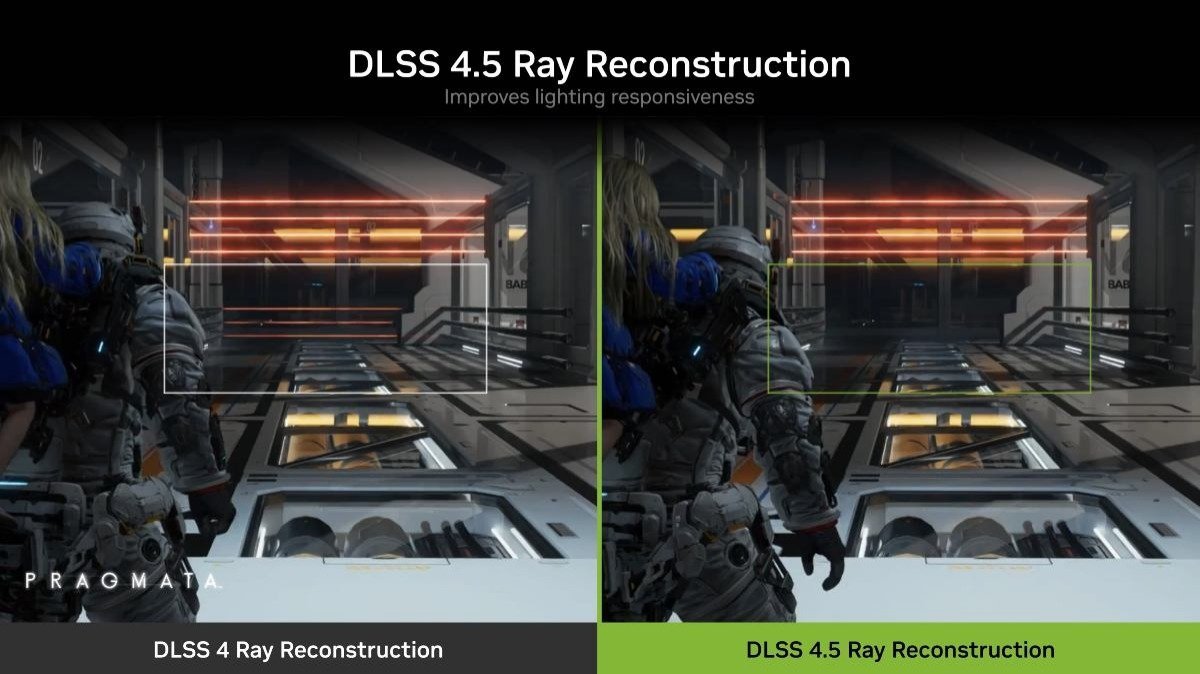
Real-time demonstrations were used to showcase the behavior of the algorithm in complex virtual environments for large-scale productions. In the scenes of Indiana Jones and the Great Circle, the mapping manages to compute and render snow surfaces with greater geometric fidelity. In the mysterious PRAGMATA, the technical reports highlighted a significant reduction in the generation of visual artifacts and quicker dynamic lighting responses, while the dense Alan Wake 2 now displays stabilized static lines on old analog screens of enclosed settings. One can subtly observe how the industry relies on controlled laboratory demonstrations to inflate the potential of secondary visual resources, diverting the audience's attention from the fact that games are hitting the market poorly optimized and necessarily relying on AI crutches to run at acceptable frame rates even on top-tier hardware.
The semiconductor manufacturer took the technology fair Computex 2026 to formally introduce its second-generation noise reduction and reconstruction model, named DLSS 4.5 Ray Reconstruction. The mechanism has been specifically designed to enhance the performance of titles that use Ray Tracing and Path Tracing illumination techniques, promising to refine the aesthetic finish on computers starting in August. The shared engineering data indicates that the system delivers 35% more raw processing capacity, operating with a 20% larger volume of simultaneous parameters in direct comparison with the previous variant made available in 2023.
The foundation of this leap in fidelity is anchored in direct branches from the DLSS 4.5 Super Resolution ecosystem. The current architecture shows an expanded spatial perception in each rendered frame, optimizing the use of motion vectors generated natively by the game graphics engine. Nvidia fed the AI with a massively expanded database to try to bring visual filtering closer to the real physical behavior of light, which should result in greater temporal stability and shading accuracy. The tool also provides studio programmers with a refined control panel over the levels of temporal accumulation, allowing for surgical precision in image calibration within the code lines. Subtly, there is a clear marketing convenience in this bombardment of technical percentages and grandiose terms. Updating post-processing algorithms serves as an excellent corporate smokescreen to justify the continuous price increase of graphics cards, forcing the consumer into an eternal cycle of component upgrades to enjoy subtle improvements that often go unnoticed in the heat of the action.
The company's engineering confirmed that owners of GeForce RTX graphics cards will be able to activate the ray reconstruction feature at the end of the upcoming winter. The ecosystem will be immediately available in an initial selection comprised of 27 compatible software titles, with the official list provided by the manufacturer described below:
Alan Wake 2
NTE
Avatar
Backrooms
Call of Duty: Black Ops 7
Crimson Desert
Cyberpunk 2077
Death Relives
Directive 8020
DOOM: The Dark Ages
Enlisted
EVERSPACE 2
F1 25
FBC: Firebreak
Half-Life 2 RTX
Hogwarts Legacy
Incursion Red River
Indiana Jones and the Great Circle
NARAKA: BLADEPOINT
Portal with RTX
PRAGMATA
Resident Evil Requiem
Samson
Star Wars Outlaws
Subliminal
Sword of Justice
The First Descendant
Subtly, there's a criticism that celebrating the increasing dependency on image reconstruction algorithms reveals the technical laziness that has taken over PC game development. Pushing performance responsibility to Nvidia's labs has become the perfect excuse for publishers to release unfinished products in virtual stores, knowing that AI tools will mask structural optimization flaws. Treating anti-aliasing and light reconstruction resources as the glorious future of video games is a dangerous value inversion, where the native software polish is sacrificed on the altar of hardware marketing, charging the player exorbitantly to deliver a visual stability that should be the basic rule of any esteemed release.

Comments
Log in to your account or create one for free on MG Community to participate in comments.